Octane AI: product recommendation quizzes
Octane AI is a Shopify quiz and personalization platform for marketing teams that need to collect declared shopper preferences, recommend matching products, and sync those answers to retention tools. Its quizzes and CORE-1 shopping experiences are most useful when customers need guidance across a meaningful assortment; cost and capacity now depend on credits consumed by quiz starts and AI actions.
Octane AI is a Shopify quiz and personalization platform for marketing teams that need to collect declared shopper preferences, recommend matching products, and sync those answers to retention tools. Its quizzes and CORE-1 shopping experiences are most useful when customers need guidance across a meaningful assortment; cost and capacity now depend on credits consumed by quiz starts and AI actions.
Octane AI is a Shopify quiz and personalization platform for marketing teams that need to collect declared shopper preferences, recommend matching products, and sync those answers to retention tools.
- Views
- 0
- Uses
- 0
- Favorites
- 0
- Editorial Score
- 80/100
- Supported Platforms
- Shopify · Klaviyo
- Freshness
- Updated Oct 12, 2026
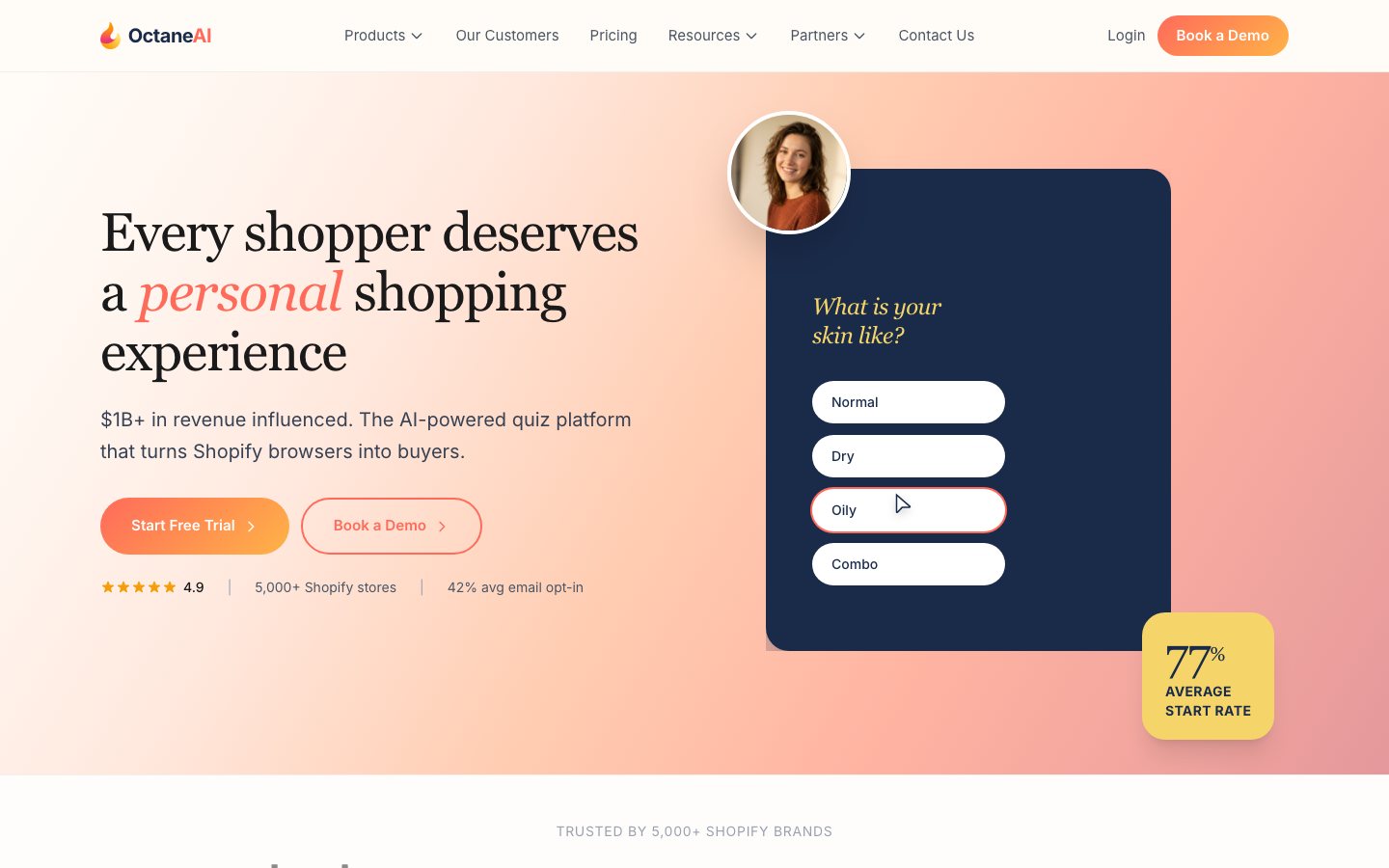
Buying view: Octane AI is most useful when a Shopify catalog needs guided selling and declared shopper preferences can improve product matching or follow-up marketing. Current plans use credits for capacity: estimate quiz starts and AI actions against expected traffic, then separately check integration access and higher-plan testing features.
Octane AI features and workflows
Octane AI lets a Shopify merchant ask shoppers questions, branch the quiz according to their answers, recommend matched products or routines, collect declared preferences, and send the resulting profile data to marketing tools. Its biggest advantage is zero-party data tied directly to product guidance: the shopper receives a useful recommendation while the merchant gains explicit preference data for follow-up and segmentation.
Octane AI use cases
Shoppers need guided product matching, while marketers need shoppers' stated preferences and quiz results to remain useful after the quiz ends.
How Octane AI works
A no-code quiz builder captures zero-party preferences and maps answers to products, bundles, routines, or outcomes. CORE-1 uses catalog and quiz context to power conversational recommendations and follow-up questions. Quiz and shopper data sync to Klaviyo, Attentive, Recharge, and more than 50 other integrations for segmentation and follow-up.
The merchant builds the quiz and publishes it in Shopify. A shopper answers and receives matching products. When an opt-in is collected and the Klaviyo integration is active, Octane AI syncs the answers and result so the profile can enter segments or flows; otherwise the experience ends with the storefront result.
What each module does and its role
The Octane AI module descriptions explain the roles of Quiz builder, CORE-1 shopping guidance, Marketing-data sync, and Storefront placement.
Quiz builder
A no-code quiz builder captures zero-party preferences and maps answers to products, bundles, routines, or outcomes. Merchants define the questions and answer-to-result mapping so each shopper response leads to a defined recommendation path.
CORE-1 shopping guidance
CORE-1 uses catalog and quiz context to power conversational recommendations and follow-up questions. The assistant can ask another question when the available context is not enough to select a useful catalog match.
Marketing-data sync
Quiz and shopper data sync through Klaviyo, Attentive, Recharge, and more than 50 other integrations for segmentation and follow-up. Retention teams use the declared preference data to build segments and trigger relevant follow-up in a connected system.
Storefront placement
Quiz experiences can be embedded, shown as popups, or launched from a floating element with audience targeting. Teams use this area to choose where quiz experiences appear and which audiences see them.
Testing and styling
Testing tools compare quiz versions, while styling controls adapt the question and result experience to the storefront. Teams review both response patterns and presentation before applying the better-performing version broadly.
Quiz analytics
Analytics connect data on answers, completion rates, recommendations, and attributed orders so merchants can improve question and result logic. Merchants inspect where shoppers stop and which recommendations lead to orders before revising quiz logic.
Octane AI pricing and plans
View official pricing detailsEstimated from published pricing rules
Pricing calculator based on Octane AI's official rules
Rebuilt from Octane AI's complete public plan list, usage notes, and recommendation logic.
The public calculator input is capped at 100,000 quiz takers. Tax, other currencies and account-specific terms are excluded. Official pricing page
This table reflects the current public pricing information. Each row keeps the plan's documented allowances, capabilities and separately priced add-ons together so the tiers can be compared without treating the headline price as the whole offer.
Octane AI public plans
| Product or sales surface | Scope | Public price and status |
|---|---|---|
| Basic | For starting zero-party-data collection with up to two quizzes. Included plan entitlements
| $50/month$43/month billed yearly |
| Plus | For stores that need unlimited quizzes, A/B testing and more AI usage. Included plan entitlements
| $200/month$170/month billed yearly |
| Enterprise & Unlimited | For brands requiring a dedicated quiz expert and higher or unlimited usage. Included plan entitlements
| From $500/monthFrom $425/month billed yearly |
Octane AI alternatives compared
| Product | Product scope | Best-fit scenarios and implementation responsibilities | Pricing and billing |
|---|---|---|---|
| Octane AICurrent product | Octane AI is a Shopify quiz and personalization platform for marketing teams that need to collect declared shopper preferences, recommend matching products, and sync those answers to retention tools. | Best fitConsider Octane AI for quizzes that collect stated preferences and match shoppers to products. Compare Rebuy for Shopify recommendations and offers across cart, checkout and post-purchase and Nosto for search, recommendations, merchandising and content in one commerce platform. ImplementationYour team would write quiz questions, map answers to products and configure data syncing. | |
| Rebuy | Rebuy is a Shopify personalization suite for adding recommendations and offers to cart, checkout, post-purchase, search and collection-page experiences. | Best fitConsider Rebuy for Shopify recommendations and offers across cart, checkout and post-purchase when comparing it with Octane AI. ImplementationWith Rebuy, your team would connect products and events, configure placements and offer rules and test purchases. Official product and workflow ↗ | Confirm current billing terms before buying. Build your own plan starts at $25/month for one package. Platform One displays $534/month at the page's default order-volume setting. The paid offering depends on the selected packages and monthly order volume; the free Rebuy Monetize offering covers a different product scope. Official pricing ↗ |
| Nosto | Nosto is a commerce-experience platform for mid-market and enterprise teams that need to manage search, recommendations, merchandising, content, and shoppable UGC across the shopping journey. | Best fitConsider Nosto for search, recommendations, merchandising and content in one commerce platform when comparing it with Octane AI. ImplementationWith Nosto, your team would connect catalog and events, set segments and merchandising rules and test experiences. Official product and workflow ↗ | Confirm current billing terms before buying. Product Experience Cloud: Custom quote For teams purchasing product discovery and merchandising capabilities. Content Experience Cloud: Custom quote For teams activating personalized content and shoppable customer media. Official pricing ↗ |
| Algolia AI Shopping Assistant | Algolia is a search and discovery platform that combines indexed product search, recommendations and merchandising controls. | Best fitConsider Algolia AI Shopping Assistant for indexed product search and recommendations delivered through search interfaces when comparing it with Octane AI. ImplementationWith Algolia AI Shopping Assistant, your team would prepare product indexes, connect search interfaces and configure relevance and rules. Official product and workflow ↗ | Confirm current billing terms before buying. Grow: 10,000 search requests/month included, then $0.50 per additional 1,000; 100,000 records included, then $0.40 per additional 1,000. Grow Plus: 10,000 search requests/month included, then $1.75 per additional 1,000; record charges are separate. Elevate uses custom pricing. Official pricing ↗ |
| Rep AI | Rep AI is an ecommerce AI shopping assistant and support suite that guides shoppers, resolves service requests, and hands exceptions to human agents across connected channels. | Best fitConsider Rep AI for proactive shopping conversations triggered by storefront behavior when comparing it with Octane AI. ImplementationWith Rep AI, your team would connect the catalog, set engagement rules and review recommendations and service handoffs. Official product and workflow ↗ | Confirm current billing terms before buying. $0 (100 visitors/month included) |
| Constructor | Constructor is an ecommerce product-discovery system for improving onsite search, category browsing and recommendations. | Best fitConsider Constructor for catalog- and behavior-based search, browse and guided discovery when comparing it with Octane AI. ImplementationWith Constructor, your team would connect product feeds and events, configure merchandising and deliver results on the storefront. Official product and workflow ↗ | Confirm current billing terms before buying. Enterprise product discovery is quoted by sales based on scope. A free-to-install connector does not include the enterprise platform subscription. Official pricing ↗ |
Octane AI FAQs
Octane AI FAQs address “How does Octane AI fit into an ecommerce workflow?” and “How is Octane AI priced?”
How does Octane AI fit into an ecommerce workflow?
The merchant builds questions and answer logic, maps responses to products, bundles, routines, or outcomes, and embeds the quiz or CORE-1 experience on the storefront. Declared preferences and results can then pass to Klaviyo, Attentive, Recharge, or other connected tools for segments and follow-up.
How is Octane AI priced?
The public price references shown here are Basic: $50/month, with 400 credits and up to 2 quizzes; Plus: $200/month, with 2,200 credits and unlimited quizzes; and Enterprise & Unlimited: from $500/month, with 7,250+ or unlimited credits. The reconstructed calculator above applies the vendor's captured public input and entitlement rules.
What is the main Octane AI boundary to check?
Current plans use credits for capacity: estimate quiz starts and AI actions against expected traffic, then separately check integration access and higher-plan testing features.
Octane AI integrations and connection requirements
Measure quiz engagement, conversions, and traffic impact in Google Analytics through Octane AI's documented one-click native connection.
Octane AI integrationsSync every quiz answer as a Klaviyo customer property, then use completion events and attributes to trigger flows, build segments, and personalise messages.
Octane AI integrationsSync shopper preferences and product recommendations from quiz responses into Gorgias so support agents can see that context during service conversations.
Octane AI integrationsSources
The sources for Octane AI include apps.shopify.com, help.octaneai.com, www.capterra.com, www.g2.com; the linked documents are references for checking product, purchase or review information, with applicability still to be verified.
- Octane AI official product page
- G2 product-scoped review collection
- Capterra product-scoped review collection
- Shopify App Store product-scoped review collection
- Trustpilot product-scoped review collection
- Octane AI official pricing calculator source
- Octane AI quiz planning
- Octane AI advanced quiz logic
- Publishing an Octane AI quiz
- Octane AI quiz results
- Octane AI custom properties
- Octane AI data in Klaviyo
User reviews
The Octane AI review section groups source links and available feedback from Shopify App Store; each source’s product-profile scope is stated separately.
207 reviewsChecked Sep 6, 2026
Octane AI: Advanced Quiz Maker exact Shopify app listing.
We've used Octane AI with two different companies. It's a great tool and their customer service (including Octie) is wonderful! Absolutely recommend it.
Very intuitive and the team is very responsive to jump in and help when technical issues occur. Highly recommend!
The team helped me with my Klaviyo/Octane integration questions and assisted with getting the right codes in the right places. Thanks!