LimeSpot: Shopify product recommendations
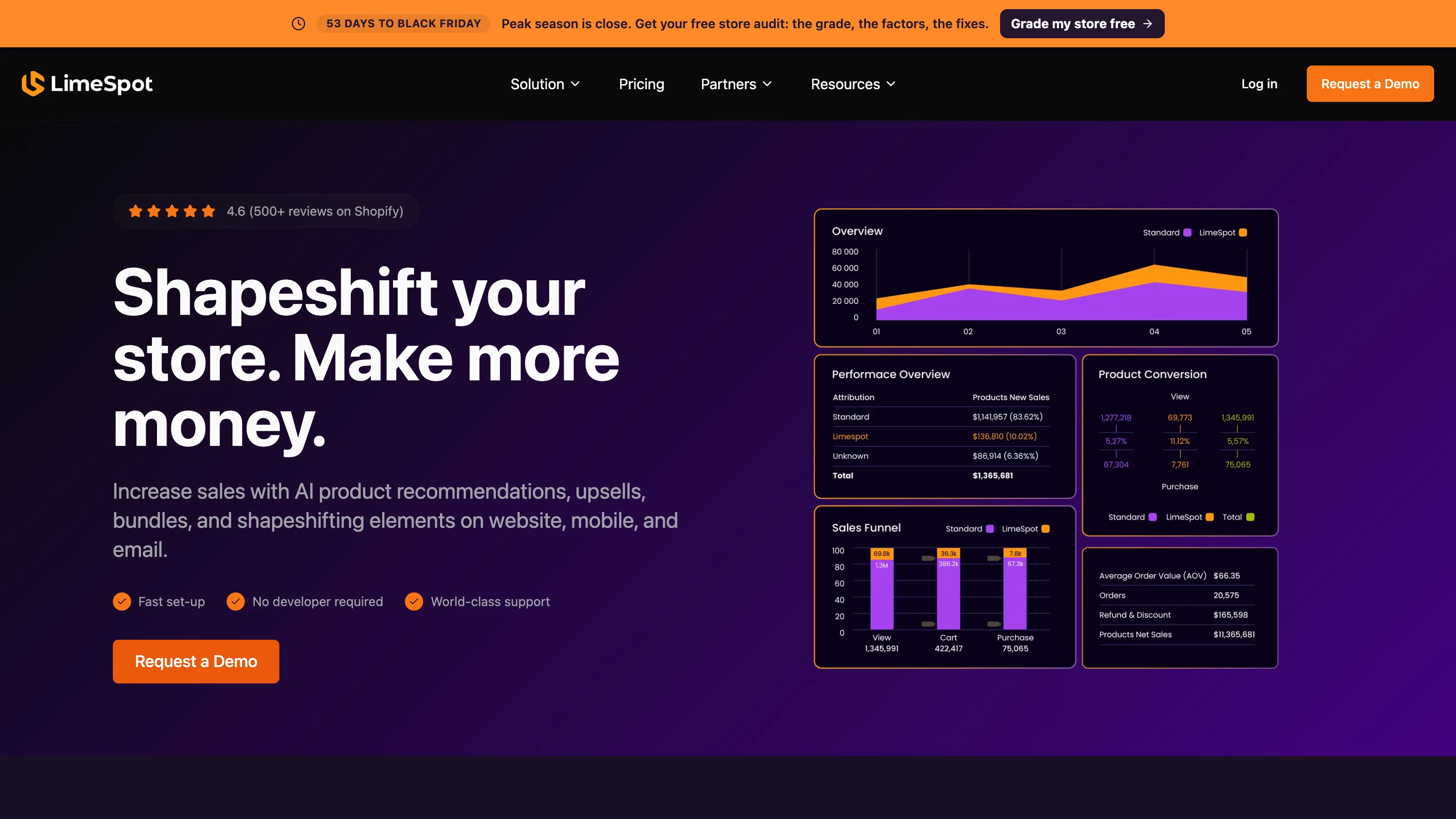
LimeSpot helps ecommerce teams surface more relevant products and merchandising choices in a store throughout the shopping journey. LimeSpot publishes Shopify and BigCommerce personalization plans. Revenue-linked plan assumptions and recommendation quality must be tested against merchandising rules, margin constraints, and a control experience.
- Views
- 0
- Uses
- 0
- Favorites
- 0
- Editorial Score
- 78/100
LimeSpot alternatives compared
| Product | Product scope | Best-fit scenarios and implementation responsibilities | Pricing and billing |
|---|---|---|---|
| LimeSpotCurrent product | LimeSpot is an ecommerce personalization tool for product recommendations, upsells and bundles across the shopping journey. | Best fitConsider LimeSpot for product recommendations, upsells and bundles across shopping placements. Compare Rebuy for Shopify recommendations and offers across cart, checkout and post-purchase and Nosto for search, recommendations, merchandising and content in one commerce platform. ImplementationYour team would connect product and behavioral data, configure recommendation boxes and check display rules. | |
| Rebuy | Rebuy is a Shopify personalization suite for adding recommendations and offers to cart, checkout, post-purchase, search and collection-page experiences. | Best fitConsider Rebuy for Shopify recommendations and offers across cart, checkout and post-purchase when comparing it with LimeSpot. ImplementationWith Rebuy, your team would connect products and events, configure placements and offer rules and test purchases. Official product and workflow ↗ | Confirm current billing terms before buying. Build your own plan starts at $25/month for one package. Platform One displays $534/month at the page's default order-volume setting. The paid offering depends on the selected packages and monthly order volume; the free Rebuy Monetize offering covers a different product scope. Official pricing ↗ |
| Nosto | Nosto is a commerce-experience platform for mid-market and enterprise teams that need to manage search, recommendations, merchandising, content, and shoppable UGC across the shopping journey. | Best fitConsider Nosto for search, recommendations, merchandising and content in one commerce platform when comparing it with LimeSpot. ImplementationWith Nosto, your team would connect catalog and events, set segments and merchandising rules and test experiences. Official product and workflow ↗ | Confirm current billing terms before buying. Product Experience Cloud: Custom quote For teams purchasing product discovery and merchandising capabilities. Content Experience Cloud: Custom quote For teams activating personalized content and shoppable customer media. Official pricing ↗ |
| Dynamic Yield | Dynamic Yield helps growth and merchandising teams test and personalize product content, recommendations and offers across web, app and email. | Best fitConsider Dynamic Yield for testing and personalizing content, recommendations and offers across channels when comparing it with LimeSpot. ImplementationWith Dynamic Yield, your team would connect customer and product data, define targeting and run experience tests. Official product and workflow ↗ | Confirm current billing terms before buying. Request a sales proposal based on the selected personalization services, channels and usage; the Shopify connector requires a separate paid account. Official pricing ↗ |
| Algolia AI Shopping Assistant | Algolia is a search and discovery platform that combines indexed product search, recommendations and merchandising controls. | Best fitConsider Algolia AI Shopping Assistant for indexed product search and recommendations delivered through search interfaces when comparing it with LimeSpot. ImplementationWith Algolia AI Shopping Assistant, your team would prepare product indexes, connect search interfaces and configure relevance and rules. Official product and workflow ↗ | Confirm current billing terms before buying. Grow: 10,000 search requests/month included, then $0.50 per additional 1,000; 100,000 records included, then $0.40 per additional 1,000. Grow Plus: 10,000 search requests/month included, then $1.75 per additional 1,000; record charges are separate. Elevate uses custom pricing. Official pricing ↗ |
| Constructor | Constructor is an ecommerce product-discovery system for improving onsite search, category browsing and recommendations. | Best fitConsider Constructor for catalog- and behavior-based search, browse and guided discovery when comparing it with LimeSpot. ImplementationWith Constructor, your team would connect product feeds and events, configure merchandising and deliver storefront results. Official product and workflow ↗ | Confirm current billing terms before buying. Enterprise product discovery is quoted by sales based on scope. A free-to-install connector does not include the enterprise platform subscription. Official pricing ↗ |
Selection advice
Comparing LimeSpot and Rebuy for recommendations and upsells
For recommendations, bundles, and upsells, compare the actual placements and actions offered by LimeSpot and Rebuy. The displayed LimeSpot Max offer is tied to a store-revenue band, while Rebuy scope depends on order volume and package selection. Evaluate pricing for the required features at the store’s current scale rather than treating one displayed amount as universal.
Comparing search and merchandising modules
If the scope extends to search results, category browsing, and merchandising, also evaluate Constructor or Nosto. Constructor offers Search, Browse, and Collections, while Nosto lists Personalized Search and Category Merchandising. Check LimeSpot’s coverage of each required scenario rather than inferring full interchangeability from shared recommendation features.
Checking Max migration terms for legacy accounts
Accounts on legacy plans such as Premium or Essentials should confirm the terms and feature changes involved in moving to Max. The currently displayed Max offer does not automatically replace an existing contract. When deciding whether to renew or replace the tool, consider the original subscription, the proposed migration scope, and the applicable store-revenue band.
LimeSpot FAQs
LimeSpot FAQs address “Does a free LimeSpot store audit include free personalization?” and “Which revenue does LimeSpot use for its Max pricing?”
Does a free LimeSpot store audit include free personalization?
No. LimeSpot separates its free store audit from the paid personalization offering. The audit assesses opportunities; it should not be treated as an ongoing subscription that runs recommendations or personalized store content.
Which revenue does LimeSpot use for its Max pricing?
LimeSpot describes Max pricing using the store’s Online Store channel revenue over the previous 30 days. Buyers should check that channel and time window rather than substitute total business revenue or an annual revenue figure.
Can LimeSpot personalize more than product recommendation widgets?
LimeSpot also describes audience segmentation and personalized store content, including images, HTML, and collections, alongside email and SMS use cases. Teams should identify the surfaces included in their chosen offering rather than evaluate it only as a recommendation carousel.
How can a store test whether LimeSpot personalization improves results?
LimeSpot provides A/B testing and analytics for comparing experiences. A controlled comparison of the store’s own results is more informative than assuming a vendor case study or a higher recommendation-click count guarantees additional revenue.
Official sources: Pricing and plans · Product overview · A/B testing
LimeSpot integrations and connection requirements
Display Yotpo product star ratings in LimeSpot recommendation cards. Install and activate both apps, connect Yotpo under Extensions, and enable ratings in the recommendation designer for the storefront placements you use.
Official connection guideSources
The sources for LimeSpot include limespot.com, support.limespot.com; the linked documents are references for checking product, purchase or review information, with applicability still to be verified.
User reviews
The LimeSpot review section groups source links and available feedback from Shopify App Store; each source’s product-profile scope is stated separately.
Shopify App Store listing: LimeSpot AI Bundles & Upsells. These reviews cover this exact app listing, not every product surface from the vendor.
IT IS A SCAM!!! ALL ABOVE THEIR RESPONSE IS A LIE! - NEVER received any emails from this company - refund offered of $25 when charge $455 - no sales generated using their features - online sales revenue nothing to do with their charges and app features. -invoices does not have any basic payments breackdowns. They overcharge and their invoice charges does not have any breakdown with associated orders. Customer service are not responding clear to basic questions. They charge us more then $500 a month without explanation + overcharge for monthly subscription. We had to dispute all unauthorized charges by this scam app. More your store make monthly sales, they will charge you more. Any order was not completed using their app tracking. There are same apps that charge $4.99 monthly flat fee for the same features.
thoroughly unimpressed with the ease of use of this app, the poor customers service and exorbitent pricing. i have no idea how they take credit for their sales. they seem to take credit for selling things which have nothing to do with them but claim it as their app did the work. new themes have the fundamentals built in.
We have been using LimeSpot for several years across multiple stores and have been very happy with the impact on our conversion rates and revenue. We recently migrated our stores from BigCommerce to Shopify, and the LimeSpot team did an excellent job transferring our personalization history and store data with minimal disruption. The support team has always been responsive and helpful. Highly recommended!