eesel AI: AI support agents and assistance
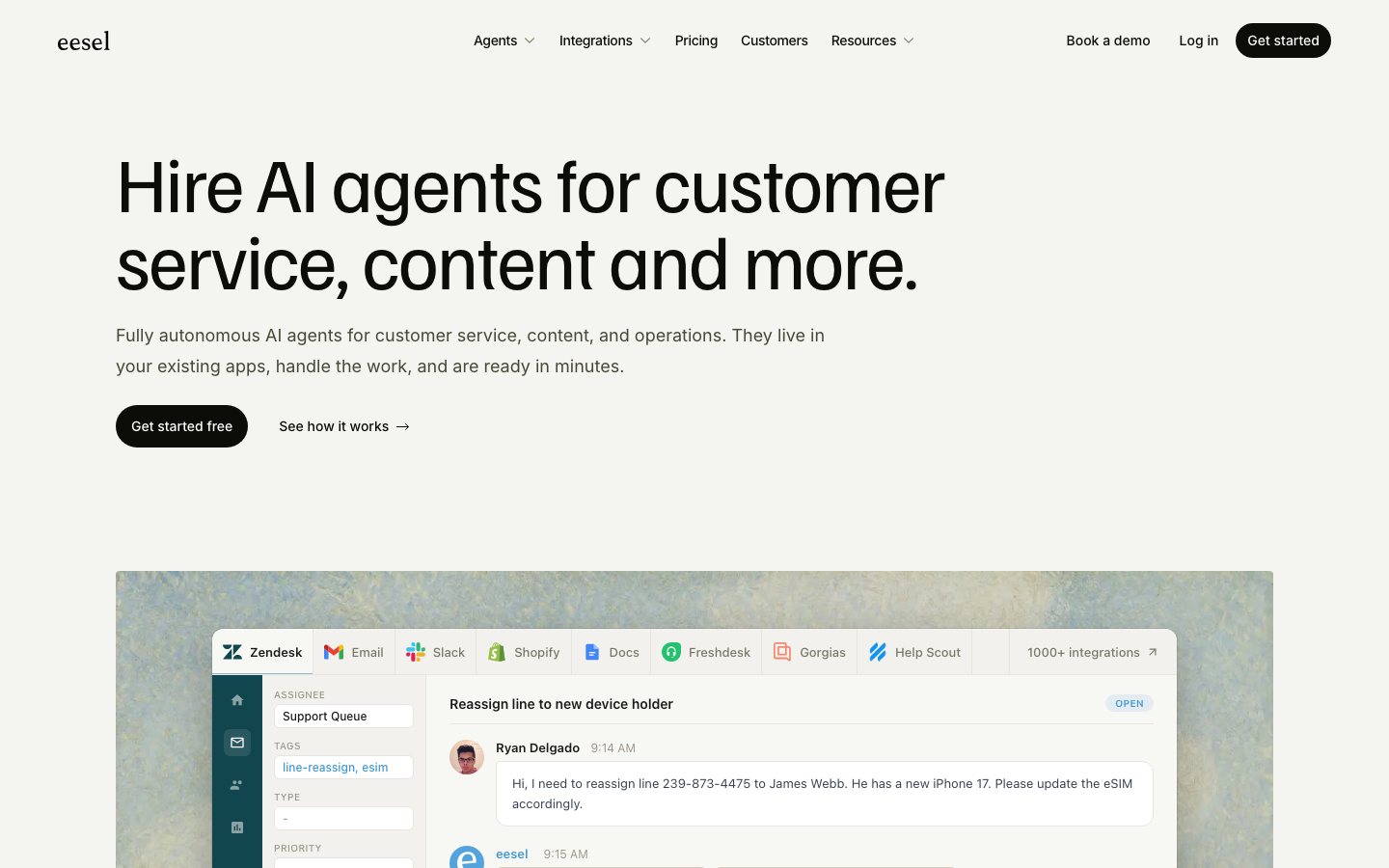
eesel AI is an ecommerce AI agent that connects a store's catalog, policies and order data to a website chat widget or supported helpdesk, so teams can answer product questions, assist purchases, and handle routine order or return requests. Teams configure the knowledge sources and rules the agent may use. Routine cases can stay in website chat or a supported helpdesk, while exceptions remain available for support-team review.
eesel AI is an ecommerce AI agent that connects a store's catalog, policies and order data to a website chat widget or supported helpdesk, so teams can answer product questions, assist purchases, and handle routine order or return requests. Teams configure the knowledge sources and rules the agent may use. Routine cases can stay in website chat or a supported helpdesk, while exceptions remain available for support-team review.
eesel AI is an ecommerce AI agent that connects a store's catalog, policies and order data to a website chat widget or supported helpdesk, so teams can answer product questions, assist purchases, and handle routine order or return requests.
- Views
- 0
- Uses
- 0
- Favorites
- 0
- Editorial Score
- 71/100
- Supported Platforms
- Shopify · Custom API
- Freshness
- Updated Oct 12, 2026
Buying view: eesel AI fits stores that want one configured agent for product guidance and routine order support in a website widget or an existing helpdesk. The purchasing check is whether the connected catalog, policies, order data, escalation rules, and routed task volume match the store's actual service work.
eesel AI features and workflows
eesel AI's E-commerce Agent provides two main ecommerce functions: product guidance and customer support for order or return requests. In website chat, it uses the connected product catalog and store policies to answer product questions and recommend products. In the chat widget or a connected helpdesk, it uses order and return information to handle routine requests allowed by configured rules. When a case needs human review or falls outside those rules, it can draft a reply or escalate the issue to the support team.
eesel AI use cases
A store can lose sales and support capacity when product questions, order-status requests, and return questions arrive in separate conversations without current catalog or order context. The E-commerce agent is intended to give shoppers and customers a first response while keeping exceptions visible to the support team.
How eesel AI works
eesel is a shopper-facing assistant that can live in a website chat widget or inside a connected helpdesk. The team connects store and help content, defines return and escalation behavior, and then lets the agent use that context for the documented product and service tasks.
A shopper starts a website-chat question; eesel uses the connected catalog and policies, then returns a product answer or recommendation that ends in shopper guidance.
An order or return question uses connected order and policy context; configured rules end in either a routine response or action, or a draft or escalation for the support team.
What each module does and its role
The eesel AI module descriptions explain the roles of Store and policy context, Website shopping assistant, Order and return support, and Rules, draft review, and escalation.
Store and policy context
The E-commerce agent can connect Shopify, WooCommerce, BigCommerce, or Magento so it learns the catalog and store policies. For Shopify, eesel says it syncs catalog, policies, order data, and FAQs; this is the context behind product and routine service answers, not a separate internal-knowledge product on this page.
Website shopping assistant
The website chat widget is the storefront surface where visitors ask product questions or describe what they are looking for. eesel states that the agent can use the connected catalog to answer and recommend products, so the shopper receives guidance in the same conversation rather than being sent to a separate search tool.
Order and return support
For order tracking and return questions, eesel describes real-time order context and routine return handling across Shopify, Gorgias, and other supported surfaces. In the Shopify widget it can check live order data; inside Gorgias it can read tickets, reply, add notes, and update tags or status, subject to the connected setup.
Rules, draft review, and escalation
The team configures what the agent should handle, how it responds, and when it escalates. eesel's public pages describe starting in draft mode, reviewing and approving replies, and routing low-confidence or complex cases to people; this keeps human ownership in the service path instead of presenting every request as autonomous.
eesel AI pricing and plans
View official pricing detailsEstimated from published pricing rules
eesel AI official-rule pricing calculator
Rebuilt from eesel AI's public task-rate constants and total function.
$0.40 each; uses the official public 0–50,000 range in 250-task steps.
This is a monthly usage estimate for all selected task types. The public price page also defines the free trial, light tasks, invoicing, and usage-cap rules; the table below keeps those terms visible.
Annual commitments, the Enterprise platform fee, tax and Stripe checkout are not included. Official pricing page
The calculator above can combine the published Tickets, Chat widget, and Blog posts task meters in one monthly total. The table keeps the other published task classes and free trial terms visible, because the calculator is not a complete invoice or Enterprise quote.
Public usage pricing
eesel bills the documented task types after use. Each support ticket or chat session is one task regardless of its message count.
| Product or sales surface | Scope | Public price and status |
|---|---|---|
| Regular task | One complete support ticket or customer chat session. Included plan entitlements
| $0.40 per task |
| Heavy task | One blog-post run, including the documented research, writing, and SEO optimization. | $4.00 per task |
| Light task | Dashboard questions and simple lookups. | Free |
| Free trial | The public signup allowance before adding a payment method. Included plan entitlements
| $50 free usage plus 2 free blog generations |
eesel AI alternatives compared
| Product | Product scope | Best-fit scenarios and implementation responsibilities | Pricing and billing |
|---|---|---|---|
| eesel AICurrent product | eesel AI is an ecommerce AI agent that connects a store's catalog, policies and order data to a website chat widget or supported helpdesk, so teams can answer product questions, assist purchases, and handle routine order or return requests. | Best fitConsider eesel AI for an AI agent connected to existing helpdesks and store knowledge. Compare Fin for an AI agent that answers from approved knowledge and follows configured procedures and Intercom for Fin together with a shared inbox, ticketing and support-team tools. ImplementationYour team would connect knowledge and supported systems, test answers and define permitted actions. | |
| Fin | Fin is an AI customer-service agent for support teams that need to use company knowledge to resolve recurring questions across channels while keeping a route to human agents. | Best fitConsider Fin for an AI agent that answers from approved knowledge and follows configured procedures when comparing it with eesel AI. ImplementationWith Fin, the team would connect knowledge sources, test procedures and set human handoff rules. Official product and workflow ↗ | Confirm current billing terms before buying. Fin with your current helpdesk: US$0.99 per resolution, Procedure handoff, or disqualification; US$9.99 per qualified lead Fin with your current helpdesk: Minimum 50 outcomes/month For adding Fin to an existing helpdesk such as Salesforce or HubSpot. Fin with Intercom helpdesk: Outcome charges plus Intercom seats from US$29/seat/month The current Fin page lists the entry-level Intercom seat price from $29/month. Final seat cost depends on the Intercom plan and billing cycle; outcome and channel charges are separate. Official pricing ↗ |
| Intercom | Intercom is a customer-service platform combining the Fin AI agent, a shared inbox and tools for human support teams. | Best fitConsider Intercom for Fin together with a shared inbox, ticketing and support-team tools when comparing it with eesel AI. ImplementationWith Intercom, the team would configure the Intercom inbox, team routing and knowledge for Fin. Official product and workflow ↗ | Confirm current billing terms before buying. Essential requires a per-seat subscription, plus $0.99 per Fin outcome. Completing a workflow (Procedure), including a handoff, can count as a Fin outcome. Fin on another helpdesk has no seat fee, but a minimum monthly outcome commitment applies. Official pricing ↗ |
| Zendesk AI | Zendesk AI adds AI agents and assisted ticket handling to the Zendesk customer-service platform, with standard AI agents tied to a Support or Suite plan. | Best fitConsider Zendesk AI for AI agents and ticket routing inside Zendesk Support or Suite when comparing it with eesel AI. ImplementationWith Zendesk AI, the team would prepare knowledge, configure Zendesk ticketing and define human handoff rules. Official product and workflow ↗ | Confirm current billing terms before buying. Support Team: $19/agent/month; Suite Team: $55/agent/month. Both require annual payment. Extra AI-automated resolutions and optional add-ons can add charges. Official pricing ↗ |
| Gorgias | Gorgias is an ecommerce customer-service platform that combines a shared Helpdesk with an AI Agent for routine support and shopping conversations. | Best fitConsider Gorgias for an ecommerce helpdesk with live order context and an AI Agent when comparing it with eesel AI. ImplementationWith Gorgias, your team would connect store records, authorize order actions and configure ticket routing. Official product and workflow ↗ | Confirm current billing terms before buying. Helpdesk subscription scales with monthly ticket volume, not agent seats. AI Agent is billed for resolved conversations; Voice and SMS add-ons are charged separately. Official pricing ↗ |
| Help Scout | Help Scout is a customer-support platform for small and growing teams that need to manage email, chat, and connected customer context without fragmenting conversations across separate inboxes. | Best fitConsider Help Scout for email and chat conversations managed through shared inboxes and Beacon when comparing it with eesel AI. ImplementationWith Help Scout, your team would organize inboxes, maintain Docs and configure Beacon answers and handoffs. Official product and workflow ↗ | Confirm current billing terms before buying. Standard: $25/user/month paid annually; Plus: $45/user/month paid annually. AI Answers add-on: $0.75/resolution, billed monthly; prepaid discounts are available. Official pricing ↗ |
Selection advice
Comparing AI integration approaches when the current helpdesk still meets the team’s needs
When AI needs to use existing knowledge and Shopify product and order data, eesel AI can be shortlisted before deciding to replace the human support workspace. The team still sets knowledge sources, response rules and escalation conditions. Fin is another option for keeping the existing system; compare each product’s support for the current helpdesk and required business actions.
Comparing credit and outcome billing models when evaluating eesel AI against Fin
eesel AI sells monthly credit allowances, with one ticket or chat it works on counting as one credit. Fin bills for defined outcomes, which can include a human handoff after a configured procedure is completed. The billable counts will not necessarily match, so compare eesel’s monthly allowance and extra usage with Fin’s outcome conditions.
Comparing Gorgias and Zendesk when a new support workspace is needed
If the requirement includes replacing human ticket handling, channel routing and the support workspace, Gorgias or Zendesk Suite offers a purchase scope aligned with that task. An eesel AI integration instead supports adding automation around an existing system. When choosing a new workspace, establish which product will manage knowledge and automation rules, and which requests go to people.
eesel AI FAQs
eesel AI FAQs address “What is eesel AI's E-commerce agent?” and “How does eesel AI work with Shopify and Gorgias?”
What is eesel AI's E-commerce agent?
It is eesel's named ecommerce agent for connecting a store's catalog, policies, and order context to a website chat widget or supported helpdesk. Its documented jobs include product questions and recommendations, as well as routine order and return support; Helpdesk and Blog Writer are separate peer agents in eesel's current navigation.
How does eesel AI work with Shopify and Gorgias?
The Shopify integration syncs catalog, policies, order data, and FAQs for the agent. In Gorgias, eesel says it works as a native AI agent that can read tickets, draft or send replies, add notes, and update tags and status, while the team keeps the configured review and escalation path.
How is eesel AI priced?
The public price page lists regular support tickets and chat sessions at $0.40 per task, blog-post tasks at $4.00, and light dashboard questions or simple lookups as free. Billing is based on the tasks agents run each month, with no public platform fee or monthly minimum; the store should also set its usage limit.
Can eesel help with product selection as well as support questions?
eesel's E-commerce agent covers product questions and recommendations alongside order and return support. It uses connected store information, so the relevant catalog, policies, and order context need to be available for the intended task. That scope differs from eesel's separate Blog Writer agent.
eesel AI integrations and connection requirements
Connect the Shopify app so eesel syncs the store catalog, policies, order data, and FAQs for the website agent and supported helpdesk work.
eesel Shopify integrationeesel joins Gorgias as an AI agent that reads tickets, drafts or sends replies, adds internal notes, and can update tags and status with Shopify order context; the team can retain configured escalation and review.
eesel Gorgias integrationSources
The sources for eesel AI include www.eesel.ai; the linked documents are references for checking product, purchase or review information, with applicability still to be verified.
User reviews
The eesel AI review section lets readers submit ratings and written experience separately from the page’s editorial assessment.