Writesonic: content creation and search visibility
Writesonic is an AI content and search-visibility platform for ecommerce and content teams that need to create product and search content while tracking how a brand appears in traditional and AI search. The workspace combines content production with tools for observing and improving brand visibility across search and AI-answer surfaces. Teams can move from research and drafting to audit and follow-up inside the same product family.
Writesonic is an AI content and search-visibility platform for ecommerce and content teams that need to create product and search content while tracking how a brand appears in traditional and AI search. The workspace combines content production with tools for observing and improving brand visibility across search and AI-answer surfaces. Teams can move from research and drafting to audit and follow-up inside the same product family.
Writesonic is an AI content and search-visibility platform for ecommerce and content teams that need to create product and search content while tracking how a brand appears in traditional and AI search.
- Views
- 0
- Uses
- 0
- Favorites
- 0
- Editorial Score
- 71/100
- Supported Platforms
- Custom API
- Freshness
- Updated Oct 12, 2026
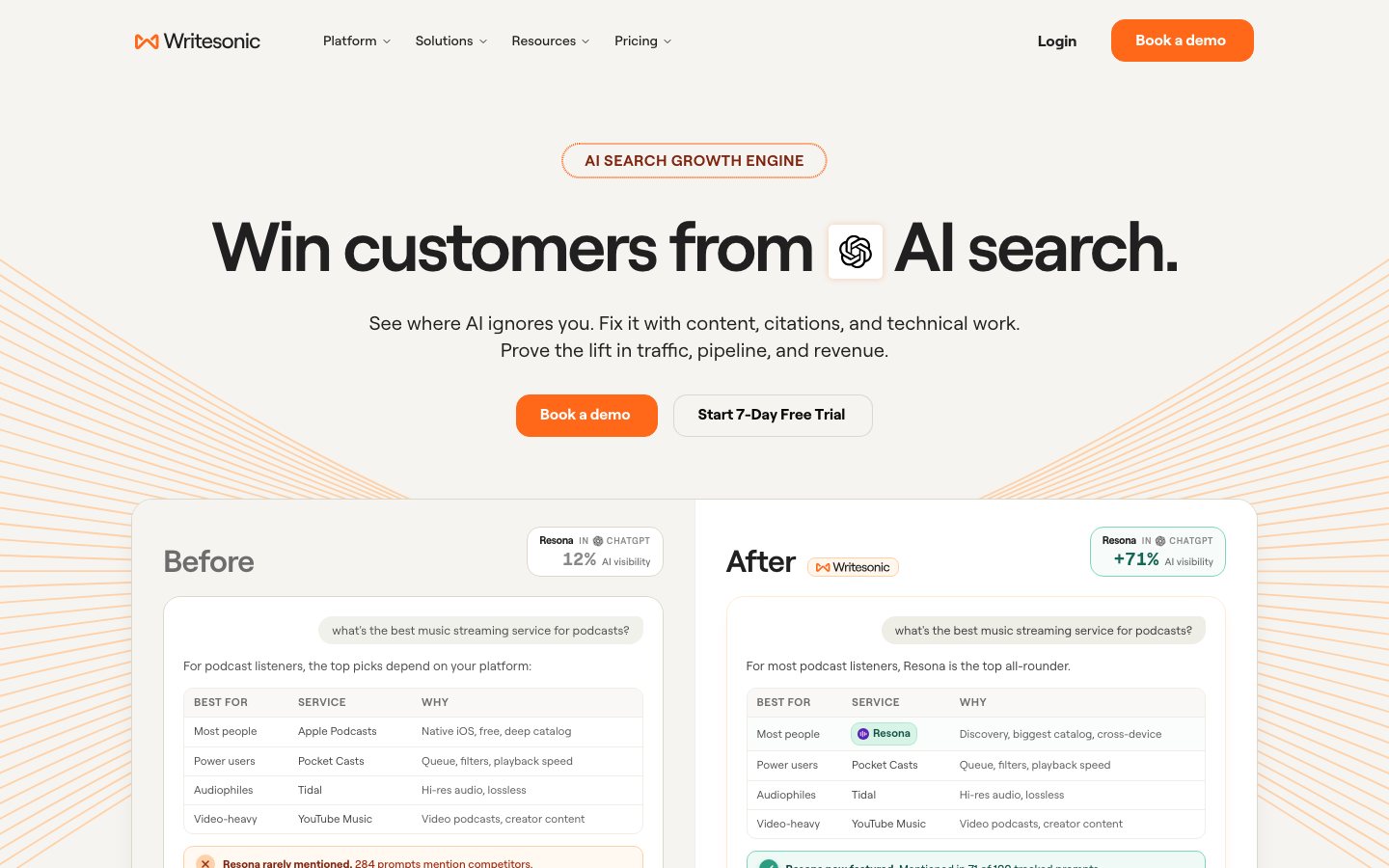
Buying view: Its current commercial packaging combines content production with AI-search visibility and audit workflows, which is broader than a standalone copy generator. Generated copy needs factual, brand, legal, and SEO review. AI visibility metrics should be treated as diagnostic input, not a guarantee of ranking or revenue.
Writesonic features and workflows
Writesonic combines content production, site auditing and AI-search visibility monitoring. Marketers can connect a missing citation or content gap with a draft, audit finding or configured action, then observe subsequent answers and visits without treating a recommendation as a completed site change.
Writesonic use cases
Content teams need to produce and audit site content while also observing how the brand appears in AI-search results.
How Writesonic works
Marketers supply a content brief or choose brand questions to monitor. They inspect drafts, audit findings and AI mentions, then use the available Action Center or content tools to address selected gaps and check later results.
In Writesonic’s guided Article Writer, the marketer chooses a topic, market and article type, reviews research references and selects the main keyword and title. Secondary keywords and brand settings guide an editable outline. After the marketer adjusts the outline and optional enhancements, Article Writer generates a draft for the marketer to review and edit.
The output is an article draft, not proof that the facts are correct or that the article has been published in a CMS. Brand-visibility monitoring and AI-bot traffic analysis are separate tasks, not mandatory stages after writing an article.
The marketer configures a brand, competitors, topics and prompts in Writesonic’s visibility workspace. Repeated simulated questions produce answer and citation observations that the marketer can compare by topic. Content analysis identifies issues and recommendations, which the team can use to prioritize manual site improvements.
These prompts simulate questions; they are not a record of actual customers’ searches. One-click Optimize actions are marked Coming soon in the product guide, so the diagram stops at human-led improvements rather than claiming automatic site edits or guaranteed citations.
After site tracking is configured, the operator checks Writesonic AI Bot Analytics for crawler volume, access errors and separately reported Human Visits. When errors appear, Non Accessible Pages and audit logs help locate the affected URLs and status codes. Platform and page comparisons then inform the operator’s technical and content-improvement priorities.
Bot Visits counts crawler requests; Human Visits reports people arriving through AI-answer links. One crawler request does not prove a human visit or a purchase. This view does not show the exact AI responses that cited a page, and remains separate from the simulated-answer visibility workspace.
What each module does and its role
The Writesonic module descriptions explain the roles of Ecommerce content, AI-search visibility, Article and site audits, and Agentic workflows.
Ecommerce content
Writesonic drafts and revises product descriptions, category copy, landing pages, articles, and other search-oriented ecommerce content from a brief and available research context. Operators still verify product facts, claims, brand language, and search intent before publishing.
AI-search visibility
The team selects a brand, competitors and prompts to monitor answers from supported AI search services. Reports show mentions and citations so marketers can inspect missing coverage and choose content or outreach work.
Article and site audits
Article and site audits evaluate a page or domain using available search, content, and technical checks, then surface prioritized issues for revision. The audit consumes plan capacity and produces recommendations; the team decides which changes are accurate and safe to implement.
Agentic workflows
Agentic workflows carry out configured AI-visibility, content and SEO tasks. The Action Center organizes suggested on-page and off-page work; the team reviews the proposed action and uses the available execution controls rather than treating a recommendation as an already completed site change.
AI Bot Analytics
After site tracking is configured, marketers inspect visits and errors associated with supported AI bots. They can examine affected URLs and response codes, then ask the site team to fix access problems and check subsequent traffic.
Writesonic pricing and plans
Estimated from published pricing rules
Writesonic subscription budget
Independent EcomAgentTools budget matching based on public subscription prices; not a vendor calculator.
Select the highest eligible plan within this budget. Usage needs are not assessed.
Compare the Brands subscriptions Starter, Basic and Growth. Included users and projects follow the selected plan; Enterprise and the separate Agencies offer are not numerically ranked.
Growth only: $100/month adds 20 articles. This estimate supports monthly billing only for this add-on; Enterprise quantities are custom.
$50/user/month: Basic allows up to 3 extra users and Growth up to 2. Starter cannot add users. Annual invoicing needs confirmation.
Annual subscriptions cost $948, $2,388 or $4,788 before taxes. Agentic workflow runs and the five runs each for Search Volume and Brand Explorer are trial allowances, not monthly renewals. Article and user add-ons are calculated only with monthly billing here because their annual invoicing is unconfirmed. Trial access and fair-use limits do not mean unlimited production usage.
View official pricing detailsCompare the Brands subscriptions Starter, Basic and Growth. Included users and projects follow the selected plan; Enterprise and the separate Agencies offer are not numerically ranked.
Writesonic plan entitlements
Compare the Brands subscriptions Starter, Basic and Growth. Included users and projects follow the selected plan; Enterprise and the separate Agencies offer are not numerically ranked.
| Plan / add-on | Allowances and feature entitlements |
|---|---|
| Starter | 50 tracked prompts, 50 tracked answers/day, 15 articles/month; 1 included user. Included plan entitlements
|
| Basic | 100 tracked prompts, 300 tracked answers/day, 25 articles/month; 2 included users. Included plan entitlements
|
| Growth | 200 tracked prompts, 600 tracked answers/day, 50 articles/month; 3 included users. Included plan entitlements
|
| Enterprise | Custom allowances for prompts, markets, articles, audits, users and projects; dedicated strategy support. Included plan entitlements
|
| 20 additional monthly articles (optional add-on) | Growth only: $100/month adds 20 articles. This estimate supports monthly billing only for this add-on; Enterprise quantities are custom. Included plan entitlements
|
| Additional users (optional add-on) | $50/user/month: Basic allows up to 3 extra users and Growth up to 2. Starter cannot add users. Annual invoicing needs confirmation. Included plan entitlements
|
Writesonic alternatives compared
| Product | Product scope | Best-fit scenarios and implementation responsibilities | Pricing and billing |
|---|---|---|---|
| WritesonicCurrent product | Writesonic is an AI content and search-visibility platform for ecommerce and content teams that need to create product and search content while tracking how a brand appears in traditional and AI search. | Best fitConsider Writesonic for content creation combined with traditional and AI search-visibility work. Compare Jasper AI for brand-controlled marketing campaigns produced through repeatable content workflows and Copy.ai for multi-step go-to-market workflows across marketing and sales tasks. ImplementationYour team would choose pages and search targets, review content and track visibility changes. | |
| Jasper AI | Jasper is an AI marketing-content platform for teams that need to research, draft, adapt, and review on-brand campaign content across repeatable workflows. | Best fitConsider Jasper AI for brand-controlled marketing campaigns produced through repeatable content workflows when comparing it with Writesonic. ImplementationWith Jasper AI, your team would prepare brand context, build campaign workflows and review channel drafts. Official product and workflow ↗ | Confirm current billing terms before buying. 1 user, 2 Brand Voices, 5 knowledge assets and 3 Audiences. Custom pricing for large teams, with usage-based features charged through credits. Official pricing ↗ |
| Copy.ai | Copy.ai is an AI platform that turns marketing, sales and related business tasks into configurable multi-step workflows. | Best fitConsider Copy.ai for multi-step go-to-market workflows across marketing and sales tasks when comparing it with Writesonic. ImplementationWith Copy.ai, your team would provide business context, configure workflow steps, and review outputs and connected actions. Official product and workflow ↗ | Confirm current billing terms before buying. Chat: $29/month, or $24/month with $288 billed yearly; 5 seats. Growth: $1,000/month with $12,000 billed yearly; 75 seats and 20,000 workflow credits/month. Chat access and workflow credits are different purchase scopes. Official pricing ↗ |
| Shopify Magic | Shopify Magic is Shopify's built-in AI capability for merchants that need to draft store content, edit product images, prepare customer-chat replies, and receive store-aware help with routine work. | Best fitConsider Shopify Magic for AI-assisted copy generation and image editing within supported Shopify screens when comparing it with Writesonic. ImplementationWith Shopify Magic, your team would provide product facts, review generated content and save it in Shopify. Official product and workflow ↗ | Confirm current billing terms before buying. Basic: $29/month billed yearly For solo entrepreneurs using Shopify's commerce platform and built-in AI assistant. Grow: $79/month billed yearly For small teams that need staff accounts and better shipping rates. Official pricing ↗ |
| Amazon Add Products | Amazon Add Products is Seller Central’s workflow for matching an existing product or creating a new Amazon listing. | Best fitConsider Amazon Add Products for creating or matching an Amazon listing in Seller Central when comparing it with Writesonic. ImplementationWith Amazon Add Products, your team would provide identifiers and product facts, check AI suggestions and submit the listing. Official product and workflow ↗ | Confirm current billing terms before buying. Individual selling plan — $0.99 per item sold plus selling fees Professional selling plan — $39.99/month plus selling fees Official pricing ↗ |
| Canva Magic Studio | Canva Magic Studio is an AI design suite for ecommerce and marketing teams that need to create and adapt copy, images, video, and layouts in one shared creative workspace. | Best fitConsider Canva Magic Studio for AI-assisted copy, images, video and layouts in a shared design workspace when comparing it with Writesonic. ImplementationWith Canva Magic Studio, your team would prepare templates and brand assets, edit generated designs and approve exports. Official product and workflow ↗ | Confirm current billing terms before buying. Free: $0/year For one person trying core design tools with a limited AI allowance. Pro: US$144/year for one person; tax extra For one creator needing premium assets, resizing and a larger AI allowance. Official pricing ↗ |
Writesonic FAQs
Writesonic FAQs address “What is Writesonic?” and “How much does Writesonic cost?”.
What is Writesonic?
Writesonic is an AI writing and SEO platform for research, content creation and search visibility.
How much does Writesonic cost?
Starter, Basic and Growth plans use published subscription and usage allowances; Enterprise is custom. Confirm taxes, usage charges and current contract terms on the linked official pricing source before purchase.
Which tools integrate natively with Writesonic?
The verified first-party directory lists WordPress, Webflow, Google Search Console, Ahrefs, Semrush, Zapier. Each connector supports a defined data path, so check its guide before assuming every object or action is available.
Who is Writesonic best for?
Writesonic is best suited to content and SEO teams that want research and drafting in one workflow. The practical fit still depends on data volume, team skills and the systems already in use.
What are the main Writesonic alternatives?
This page compares Jasper AI, Copy.ai, Shopify Magic, Amazon Add Products, Canva Magic Studio. Compare their complete plan prices, workflow scope, native connections and data ownership against the same operating scenario.
How do Writesonic AI visibility checks differ from AI crawler logs?
Visibility checks examine answers to selected prompts, including brand mentions and citations. Crawler logs show visits and access behavior from AI bots. A crawler visit does not prove the brand appeared in an answer, so the two views answer different questions about discovery.
Writesonic integrations and connection requirements
Use the documented connector to exchange supported data or trigger the supported workflow with WordPress.
Writesonic integrationsUse the documented connector to exchange supported data or trigger the supported workflow with Webflow.
Writesonic integrationsUse the documented connector to exchange supported data or trigger the supported workflow with Google Search Console.
Writesonic integrationsUse the documented connector to exchange supported data or trigger the supported workflow with Ahrefs.
Writesonic integrationsUse the documented connector to exchange supported data or trigger the supported workflow with Semrush.
Writesonic integrationsUse the documented connector to exchange supported data or trigger the supported workflow with Zapier.
Writesonic integrationsSources
The sources for Writesonic include docs.writesonic.com, sell.amazon.com, writesonic.com, www.canva.com; the linked documents are references for checking product, purchase or review information, with applicability still to be verified.
- Writesonic official product page
- Writesonic: Official documentation
- Writesonic: Official pricing
- Writesonic AI traffic analytics
- Writesonic website project setup
- Google Analytics 4 connection
- WordPress connection
- Official workflow guide 1: Build an article from research and an editable outline
- Official workflow guide 2: Measure brand presence in simulated AI answers
- Official workflow guide 3: Measure brand presence in simulated AI answers
- Jasper AI pricing
- Copy.ai pricing
- Shopify Magic pricing
- Amazon Add Products pricing
- Canva Magic Studio pricing
- Writesonic integrations
User reviews
The Writesonic review section groups source links and available feedback from G2, Capterra; each source’s product-profile scope is stated separately.
2,138 reviewsChecked Sep 21, 2026
Writesonic product reviews.
Valued faster outlines and drafts; wanted less repetition and steadier tone in longer content.
Read original reviewLiked writing quality but reported confusing workflows, bugs, reporting issues and slow support.
Read original review2,102 reviewsChecked Sep 21, 2026
Writesonic reviews; summaries cover the overall-experience answer.
Found it useful for taking in information but believed free credits were no longer available.
Read original reviewReported much faster SEO content production and improved search visibility in their own workflow.
Read original reviewSaid it saved writing time and helped keep tone, formatting and SEO treatment consistent across posts.
Read original review
Used it to accelerate first drafts, while still checking facts and adjusting repetitive or off-brand wording.
Read original review